

The Hollow State
How Power Became Procedural in America's First Week of 2026
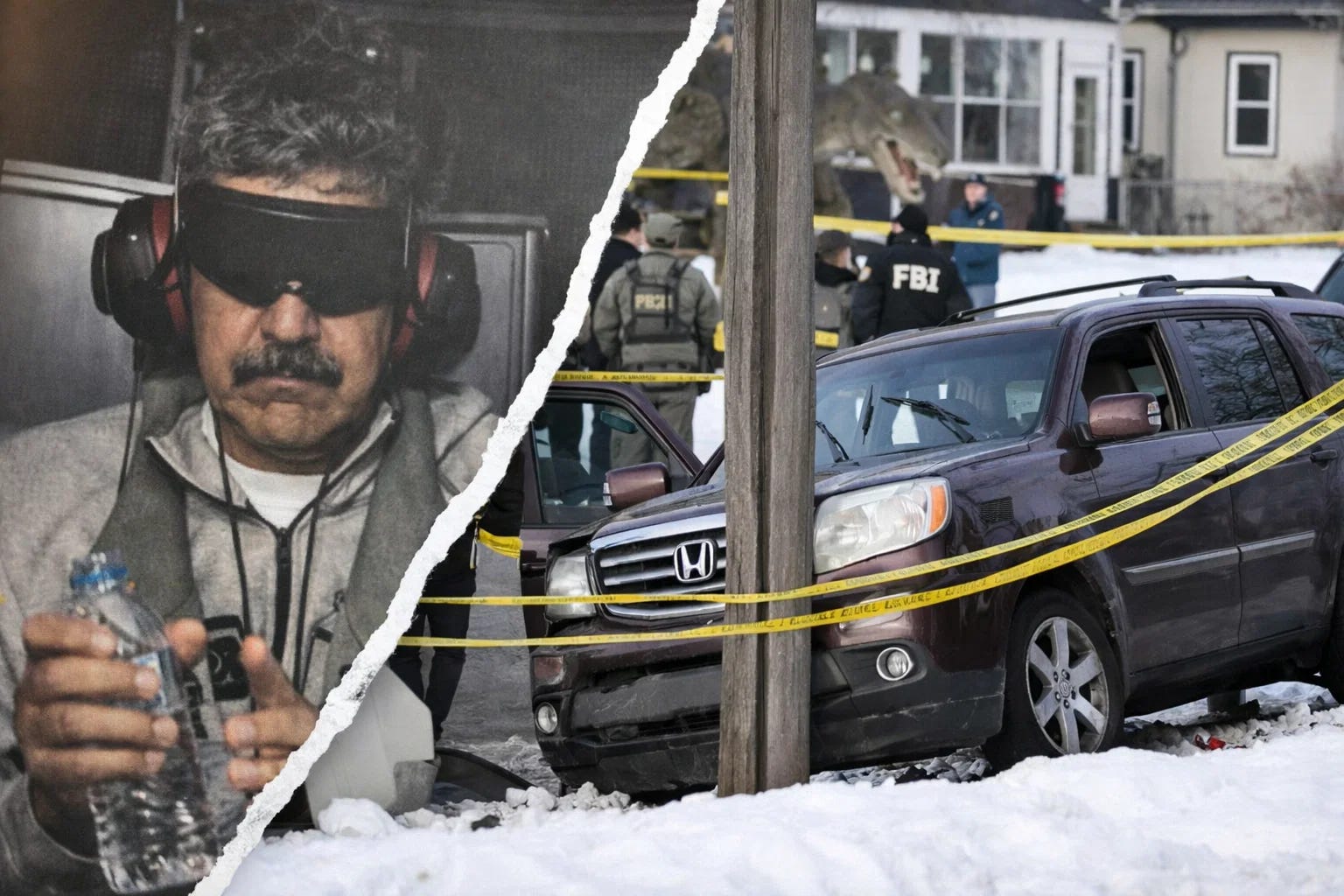
By the first full week of 2026, the United States had already established a governing rhythm for the year ahead.
Federal agents arrested a civilian critic during a televised protest. Days later, another U.S. citizen was killed during a domestic enforcement operation. In both cases, officials stressed legality. Procedures were followed. Statements were issued. Oversight was deferred. Nothing, on paper, appeared extraordinary.
That is the point.
What distinguishes the opening days of 2026 is not the presence of force but its treatment as routine. Arrests are framed as compliance measures. Killings are framed as operational outcomes. The language of law enforcement absorbs acts that would once have demanded public reckoning and renders them administratively complete.
This is not escalation through spectacle. It is escalation through normalization.
Each incident is presented as isolated. Each is justified within existing authority. And yet, taken together, they reveal a shift in how the state understands its relationship to the public. Dissent is no longer addressed politically. It is managed procedurally. Harm is no longer denied. It is documented and closed.
The result is a form of governance that does not need to announce itself. Power is exercised through discretion rather than decree, through enforcement rather than debate. The system remains intact. The rules remain in place. What has changed is who they are applied to—and how easily.
To understand what the United States is doing abroad in 2026, it is necessary to begin here. The domestic front is the blueprint.
The Internal Front — Rule by Fear
The governing rhythm was already visible at home.
On January 3, 2026, police in Grand Rapids, Michigan, arrested Jessica Plichta, a 22-year-old preschool teacher, minutes after she criticized Trump’s Venezuela operation during a local news interview. She was the only demonstrator detained out of more than two hundred gathered downtown. The charges — obstructing a roadway and failure to obey a lawful command — were minor, but the timing made the message unmistakable: dissent could be punished through discretion alone. Video of her arrest ricocheted across social media as both spectacle and warning. Visibility itself had become a liability.
Four days later, that message turned lethal.
On January 7, 2026, a U.S. Immigration and Customs Enforcement (ICE) agent fatally shot Renée Nicole Good, a 37-year-old Minneapolis woman, during a federal enforcement operation in the city’s Central neighborhood. The Department of Homeland Security described the shooting as self-defense, claiming Good attempted to use her vehicle as a weapon.
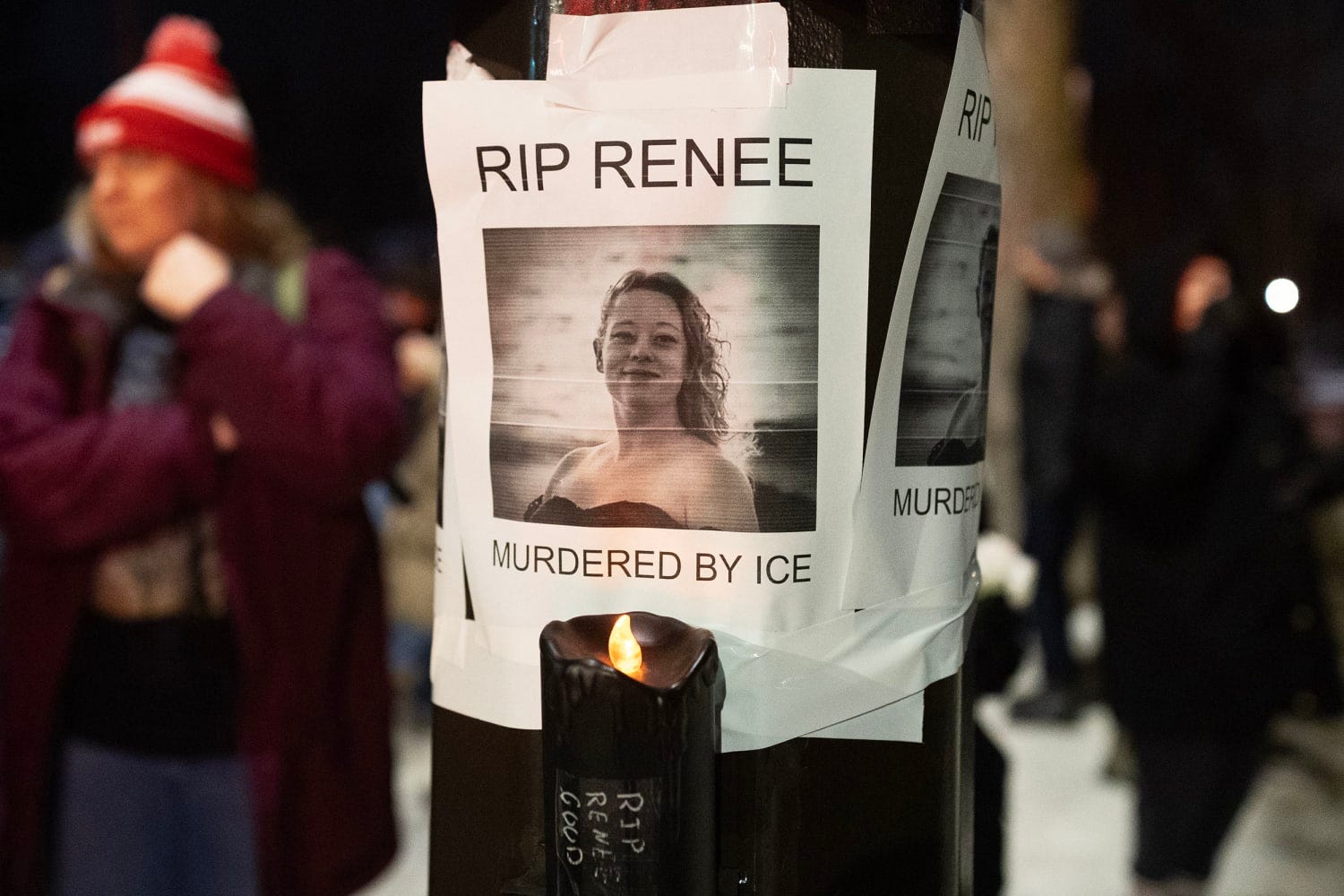
Local leaders rejected that account. Minneapolis Mayor Jacob Frey said video evidence he had reviewed contradicted the federal narrative, calling the characterization “garbage.” Minnesota Governor Tim Walz likewise challenged the administration’s framing, linking the killing to the broader surge in federal enforcement and demanding accountability and transparency.
Within days, the investigation itself was reclassified as a federal matter. The FBI assumed exclusive control of the case, cutting state investigators out of evidence access and decision-making. Minnesota officials publicly objected, warning that the move further reduced transparency and local oversight. The incident was no longer just an act of force; it was an exercise in jurisdictional control.
As protests spread, state security infrastructure moved into position. The Minnesota National Guard was placed on standby, officially as a precautionary measure. The posture underscored the new equilibrium: federal agents conduct lethal operations, federal authorities control the investigation, and state forces prepare to manage the public response.
Good’s killing was not isolated. In the days that followed, federal agents shot and wounded civilians during enforcement operations in Portland. Independent tracking shows a growing number of shootings tied to immigration enforcement since mid-2025, now accelerating into 2026.
The response followed a familiar script. Statements were issued. Procedures cited. Oversight deferred. Harm was documented and closed.
At the end of December, Tom Homan, the administration’s “Border Czar,” had previewed the escalation in ICE arrests with characteristic bluntness: “Numbers [will] explode greatly next year.” Congress’s One Big Beautiful Bill Act ensured it. The $170 billion appropriation nearly tripled ICE’s enforcement funding and poured billions more into detention and deportation infrastructure — resources now visible in the militarized rhythm of American streets.
This is how authoritarianism domesticates itself. Violence becomes procedure. Repression becomes paperwork. Once harm is absorbed as routine at home, the system no longer treats discretion as a boundary — only as a tool.
Misinformation After the Killing
In the aftermath, social media saw a wave of misrepresented and fabricated images related to the shooting, including false attributions of unrelated photos and misleading depictions of the officers involved. Fact-checkers noted that several widely shared clips and images were inaccurately linked to the incident, complicating the public’s understanding of what actually occurred.
The External Front — Rule by Force
As a state learns to absorb force as routine at home, it stops treating borders as moral limits.
On January 3, 2026, before dawn, U.S. forces executed what the White House described as a “limited extraction operation” in Venezuela. The target was Nicolás Maduro, the country’s sitting president. The operation was framed not as an act of war, but as enforcement — the execution of outstanding criminal charges under U.S. law.
Within hours, President Trump made the scope of that logic explicit. Speaking from Mar-a-Lago, he said the United States would “run the country until such time as we can do a safe, proper and judicious transition.” Administration officials emphasized legality, process, and stabilization. The language was familiar: enforcement, order, necessity.
This framing mattered. By presenting the seizure of a foreign head of state as a law-enforcement action rather than a military intervention, the administration collapsed the distinction between domestic policing and international force. What would once have required congressional authorization, multilateral coordination, or a declared state of war was rendered administratively complete.
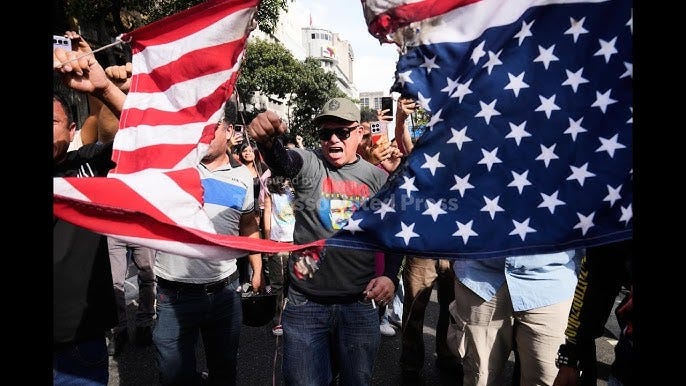
The global response was swift. An emergency session of the United Nations Security Council convened as diplomats from allies and adversaries alike condemned the operation as a violation of international law and a dangerous precedent. Governments that had long defended the U.S.-led rules-based order warned that the action undermined the very norms Washington once claimed to uphold.
Inside the United States, the response followed a different script. Conservative media figures praised the operation as decisive leadership. Legal debates focused not on whether force should have been used, but on how it had been categorized. The question was no longer why the United States acted, but which procedural framework could be invoked to justify it.
That inversion is the point. The Venezuela operation was not an aberration. It was the external application of a governing rhythm already visible at home — force exercised through discretion, normalized through procedure, and insulated from scrutiny by its own legality.
Misinformation After the Raid
In the immediate aftermath of the raid, AI-generated videos and manipulated images flooded social media, depicting jubilant Venezuelans “thanking” U.S. forces for Maduro’s capture. Fact-checkers quickly traced the clips to old protests and U.S. diaspora gatherings, but not before they were amplified by prominent accounts and algorithmically boosted into trending status. The disinformation served a purpose: to transform a unilateral assault into an image of liberation, erasing the boundary between propaganda and perception.
The Institutional Collapse — Rule Without Law
What makes this governing rhythm durable is not force alone. It is the dismantling of the institutions designed to constrain it.
By January 2026, the federal oversight infrastructure meant to investigate state abuse, enforce civil rights, and resist political interference was no longer merely weakened—it was failing. Some offices had been dismantled outright. Others were stripped of staff, authority, or independence. Together, they formed a vacuum in which force could proceed with less scrutiny, fewer witnesses, and no meaningful review.
At the Department of Justice, this collapse was deliberate. The Civil Rights Division, once responsible for investigating police abuse and enforcing constitutional protections, lost more than 70% of its attorneys after new leadership took over in early 2025. Ongoing investigations into law enforcement misconduct and the mistreatment of migrants were abandoned or dismissed. Pattern-or-practice cases were closed. Consent decrees were withdrawn. What remained was a repurposed division focused on selective enforcement aligned with the administration’s political priorities, no longer functioning as a check on state violence.
The Public Integrity Section—the firewall against politicized prosecutions—was dismantled in parallel. Its staff was cut from thirty prosecutors to five. Its authority to review or initiate new corruption cases was suspended. Career prosecutors resigned after being pressured to drop cases involving political allies or to transfer sensitive matters to loyalist U.S. Attorneys. With that authority removed, there was no internal gatekeeper left to block retaliation or pretextual prosecution.
The Justice Department’s internal watchdogs were neutralized as well. Inspectors General faced budget cuts and pressure campaigns. Ethics counsel who once blocked improper directives were fired outright. Professional responsibility offices lost senior staff and jurisdiction. The effect was structural: when senior officials ignored court orders, altered case guidance, or imposed political filters on enforcement, there were no longer internal channels capable of opening investigations, logging violations, or forcing correction. The record simply stopped accruing.
At the Department of Homeland Security, the erosion was even more explicit. In March 2025, DHS dissolved its Office for Civil Rights and Civil Liberties, laying off more than 100 staff and freezing hundreds of active investigations. Complaints of abuse—by ICE, Border Patrol, or detention contractors—lost their destination. Immigration attorneys described cases in which detainees were disappeared, denied medical care, or wrongfully deported, with no official left to receive the complaint, let alone investigate it. Although the office was later nominally reinstated, it returned with a skeletal staff and no functional capacity.
The Department’s Inspector General, weakened by leadership changes and access restrictions, was unable to fill the gap. Complaints once handled by civil rights offices were rerouted there without additional authority or resources. Audits stalled. Whistleblowers were ignored. Oversight existed in name only.
The consequences of this hollowing are not abstract. When federal agents use force, there is often no longer an independent body capable of examining it. Investigations are centralized, access is restricted, and accountability—if it comes at all—must now be improvised by state officials or courts operating without cooperation or evidence.
This is not a breakdown in coordination but the predictable result of removing the institutions that once investigated state violence, enforced civil rights, and blocked politicized enforcement. Violence no longer requires secrecy to proceed. It requires only the absence of friction.
That absence has now been built.
The Mechanism — How It All Works
What distinguishes this moment is not the scale of force, but the system that makes its use durable.
The governing logic now in place does not rely on chaos, secrecy, or overt suspension of law. It relies on procedure. Each action is framed as legal. Each decision is processed through existing authority. Each outcome is documented, reviewed, and closed—often by the same institutions that carried it out. Nothing appears extrajudicial. That is precisely why it holds.
The first component is semantic control. Violence is not denied; just renamed. Arrests become compliance measures. Killings become operational outcomes. Military actions become enforcement. Language absorbs the act, stripping it of political meaning and relocating it inside bureaucratic vocabulary. Once renamed, the act no longer demands public reckoning. It demands only administrative completion.
The second component is jurisdictional capture. Oversight is not abolished; it is consolidated. Investigations are centralized inside federal agencies. State authorities are excluded. Independent review is deferred or rendered impossible by access restrictions. When scrutiny is unavoidable, it is handled internally, under the same chain of command responsible for the original action. The appearance of review remains. Its independence does not.
The third component is institutional hollowing. Offices designed to slow, question, or refuse unlawful directives are dismantled, defunded, or repurposed. Career officials leave. Internal watchdogs lose staff, authority, or jurisdiction. What remains are fewer people, with less protection, tasked with executing policy rather than evaluating it. Resistance becomes personally risky. Compliance becomes the default.
Together, these elements produce a system that does not need to suppress dissent directly. It renders dissent administratively irrelevant. Harm is recorded, categorized, and closed. Appeals are routed into processes that no longer function. Accountability is not denied; it is postponed indefinitely.
The system is self-reinforcing. Each incident handled this way establishes precedent for the next. Each internal review that produces no consequence trains the bureaucracy to expect none. Over time, force becomes not an exception to governance but one of its tools—used quietly, legally, and without interruption.
This is not the collapse of order. It is its refinement.
The machinery still turns. The laws remain on the books. Courts convene. Forms are filed. But the friction that once made those processes meaningful—the capacity to say no, to investigate independently, to impose consequence—has been systematically removed. What remains is governance by discretion: power exercised without declaration, normalized through repetition, and insulated by its own procedures.
That is how a state stops needing to announce itself.
Every democracy imagines it will recognize the moment before it breaks. It expects spectacle—tanks, decrees, sudden darkness. What it rarely anticipates is continuity.
In the first days of 2026, the United States did not abandon its institutions. It simply used them. Arrests were processed. Investigations were opened and closed. Oversight was acknowledged and deferred. Courts convened. Statements were issued. Everything functioned, except the part that resists.
That is the mistake embedded in how we talk about democratic decline. We look for collapse when the real shift is refinement. The system does not fail; it adapts. Force is normalized. Oversight is proceduralized. Accountability is absorbed into review structures that no longer constrain outcomes. The machinery continues to operate, just toward a different end.
This is why the domestic front matters more than any single foreign operation. It reveals the governing assumption beneath everything else: that dissent can be managed, harm can be documented and closed, and power can be exercised without ever needing to justify itself politically. Once that assumption takes hold at home, its application elsewhere is no longer a question of escalation. It is simply consistency.
Nothing in the opening days of 2026 required new laws or emergency declarations. The tools already existed. What changed was how they were used—and who was no longer able to say no.
This is not the end of democracy. It is the moment democracy becomes administrative.
And by the time that shift is visible, it has already been in effect.
A brief note: My absence since the last piece was due to a family loss. I appreciate everyone who found this work in the meantime. Critical Resistance will return to regular publishing for 2026.
Navigating Critical Resistance
Analyses - In-depth breakdowns examining the systems driving democratic collapse—exposing threats, tactics, and timelines to empower informed resistance.
Playbooks - Actionable strategic guides that directly respond to each analysis, providing comprehensive step-by-step resistance plans designed for immediate implementation.
Insights - Timely, targeted pieces highlighting critical events, emerging threats, and essential context—keeping you ahead of developments as they unfold.
Profiles – Investigative deep dives into the individuals driving America’s authoritarian shift—tracking how key figures build influence, shape institutions, and operate without public accountability.
Strategy - Concise tactical guides for active resistance in motion. These pieces distill complex threats into clear pressure points and practical actions—equipping you to disrupt systems, fracture narratives, and apply strategic force where it counts.
Subscriber Fee Transparency: Subscription fees directly support independent journalism, critical research, and resources for resistance.
Prefer a one-time support option?
Good to read you again, but only if you have taken much needed, important time. Your personal loss, coupled with the horrific events of this once great nation is too much to bear. Had my Mom not passed in 2016, and she was present to witness this after growing up in the depression, WWII, Civil Rights, Viet Nam, and losing my dad at such a young age, well, I am grateful she was called home before THIS! Welcome back, Blessings for peace to you!
Good to hear from you. It's been a minute.